
Rest and recovery
Sleep, rest days, soreness, deloads and when to rest completely.
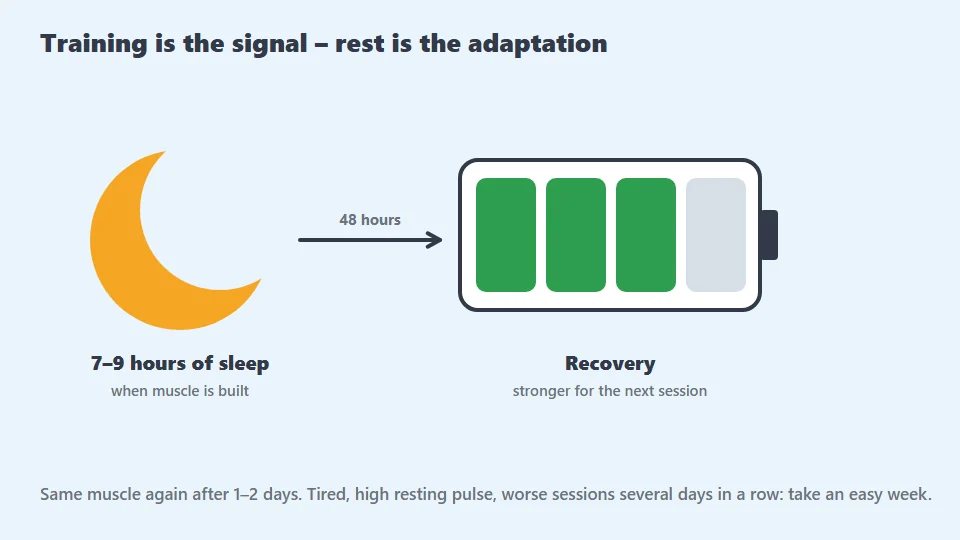
Training is the signal. The adaptation – stronger muscles, better fitness – happens between workouts. Without recovery you only train yourself tired.
Sleep
7–9 hours is the usual advice for adults. Studies of sleep loss show reduced strength, increased appetite and lower muscle building. Regular sleep times are probably worth more than most supplements.
Rest days
The same muscle group usually needs roughly 48 hours between heavy workouts, but it varies with volume and experience. Full body three times a week with a day between therefore works well for most. A walk on the rest day is a good way to move without loading – whether it speeds recovery is unclear, but it does no harm.
Soreness
Normal 24–72 hours after new exercises or higher volume. It fades quickly as the body adapts and is not a measure of how good the workout was. Light movement often feels relieving. Training through soreness is fine, but not through joint pain.
Deload
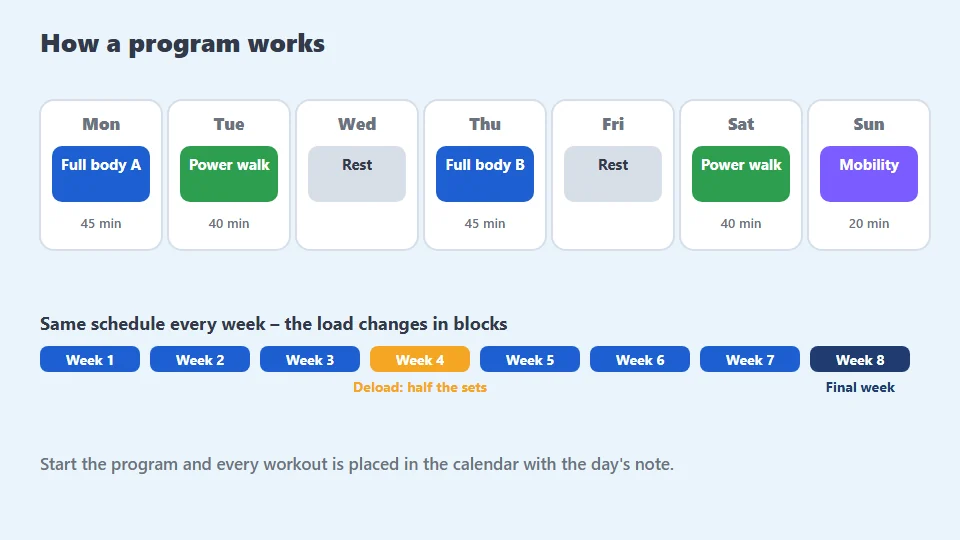
Every fourth to eighth week: same weights, half the sets, or 60–70 percent of the weights with the same sets. The programs have it built in. Research support is limited, but it is common practice. Signs you may need one earlier: weights stall three workouts in a row, sleep worsens, motivation vanishes.
Sick or injured
A common rule of thumb: cold above the neck – an easy walk is fine, heavy training waits. Fever or chest symptoms: rest fully until at least a couple of days after it clears, and ask a doctor if unsure. Joint pain that does not settle in a week: change exercise and seek help if it does not calm down.
Stress
Work, lack of sleep and training draw from the same account. A heavy week at work is a good time for a deload. Making the workout a little shorter often beats skipping it – but sometimes rest is the right call.
Sources and further reading are in the app under Learn. Passboken gives general advice and does not replace a doctor or dietitian. · Updated 2026-10-26
Programs that follow this
Get the app, pick the program and tap Start – the workouts are placed in your calendar and can be moved. Free, no ads.
Read more