
Building muscle
Progressive overload, sets per week, reps, rest and protein.
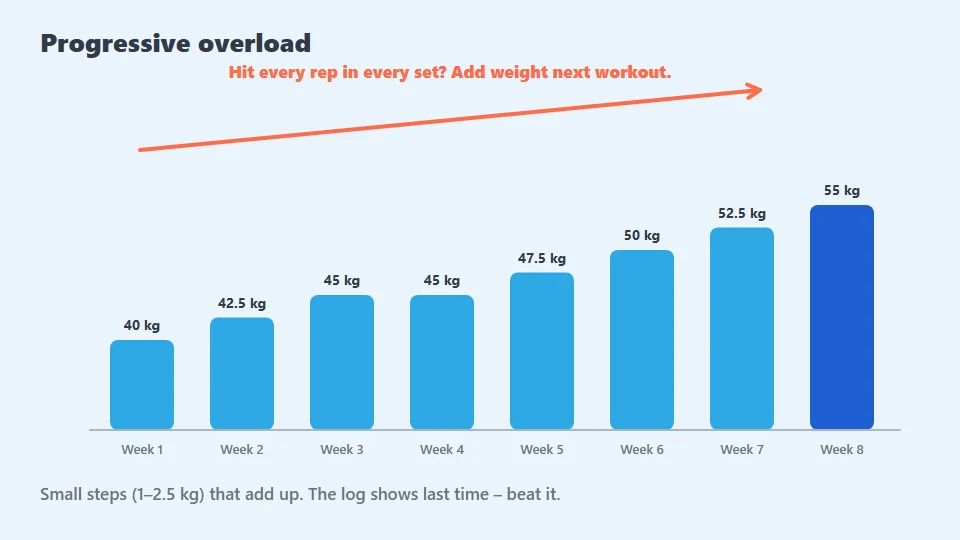
Muscle grows when it is exposed to more than it is used to and then gets rest and protein. Most of the rest is fine-tuning.
Progressive overload
Increase something over time: the weight, the reps, the sets or how close to failure you go. Simplest rule: when you hit the top of the rep range on all sets, add weight next workout by the smallest step (1–2.5 kg on dumbbells, 2.5–5 kg on a barbell). The app shows last time's weight and reps on every set – that is your progression.
How much
- 10–20 sets per muscle group per week is a common guideline backed by meta-analyses. Beginners usually get good results already in the lower half.
- 6–12 reps for the big exercises, 10–15 for isolation are practical guidelines. Research shows anything from roughly 5 to 30 reps builds muscle if the set is hard enough.
- Two to three times per muscle per week is a common layout. With total volume equal, frequency seems to matter less, but more sessions make the sets easier to do well – hence full body three times a week for beginners.
How heavy
The last two reps should be hard, but keep 1–3 reps in reserve (RIR 1–3). Studies suggest sets to complete failure build about as much muscle as sets with a few reps left – but with more fatigue, so most people do best saving it for the last set of isolation exercises.
Rest between sets
2–3 minutes on heavy compounds (squat, deadlift, bench press), 60–90 seconds on the rest are common guidelines. Too short a rest often means fewer reps next set and therefore less volume.
Protein and energy
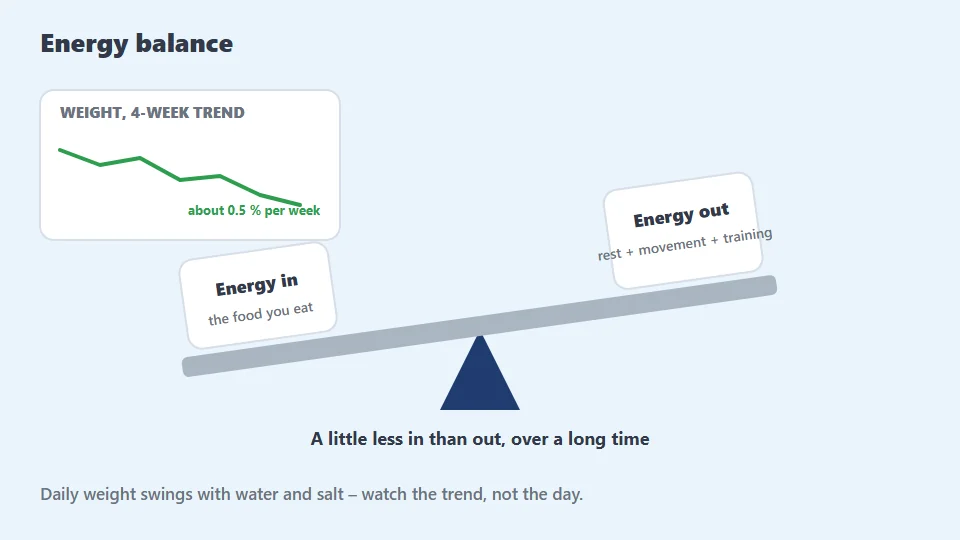
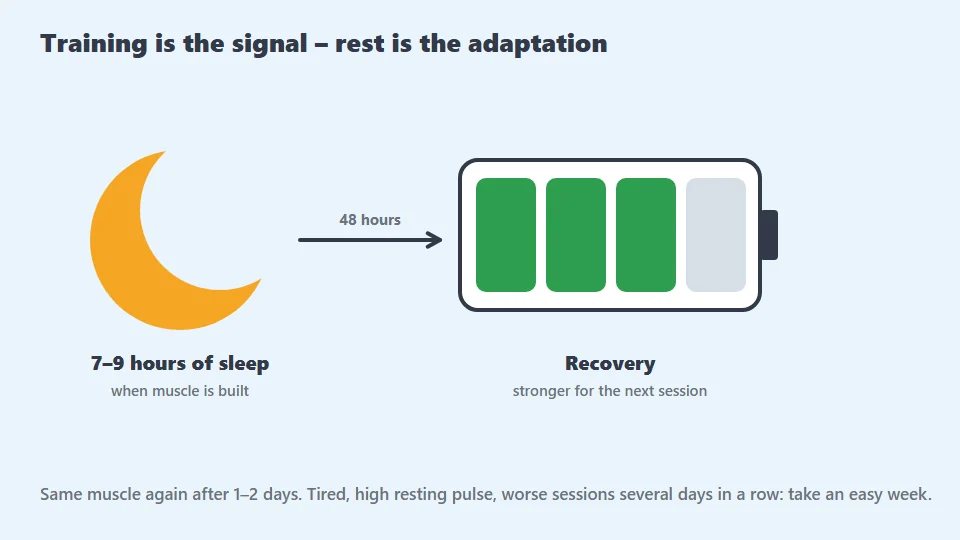
1.6–2.2 grams of protein per kilo of body weight per day is the range meta-analyses point to; a common tip is to spread it over 3–4 meals with 25–30 grams each. A small energy surplus (about 200–300 kcal) helps if you want to grow – Food has a calculator. Sleep 7–9 hours: lack of sleep impairs both recovery and muscle building.
How fast
Rough estimates for beginners are up to 0.5–1 kg of muscle a month in the first year under good conditions, with large individual variation – women often about half that in absolute terms. The rate then slows year by year. Strength rises faster than muscle shows – trust the log.
Sources and further reading are in the app under Learn. Passboken gives general advice and does not replace a doctor or dietitian. · Updated 2026-10-26
Programs that follow this
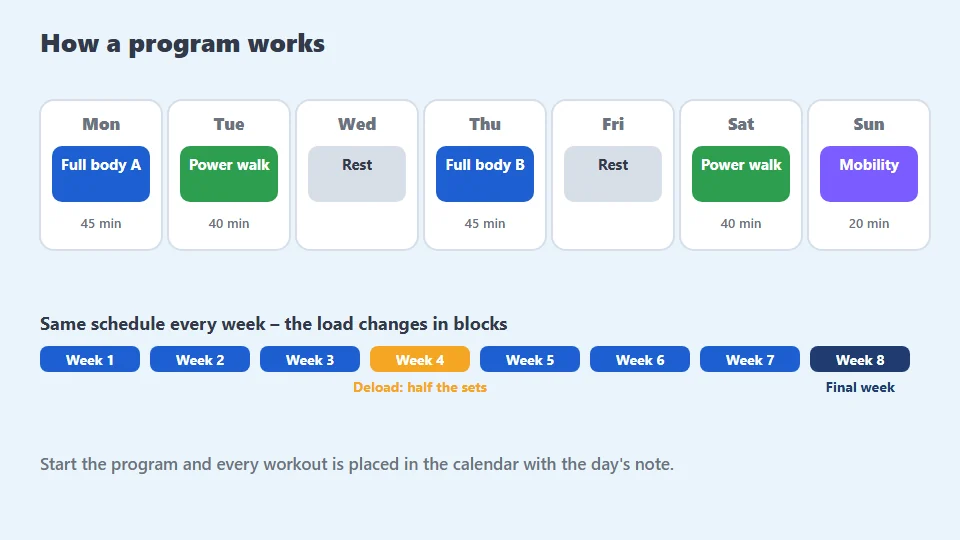
Get the app, pick the program and tap Start – the workouts are placed in your calendar and can be moved. Free, no ads.
Read more