
Becoming a police officer – the fitness tests
The swim test, the bike test and ISOKAI: what is required, how to train and what is about to change.
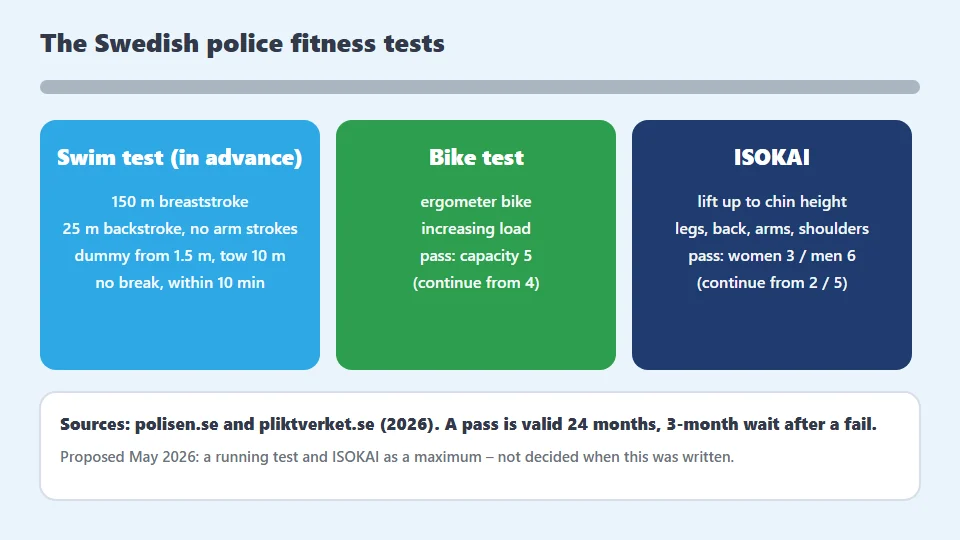
The road to the Swedish police academy goes through the Swedish Defence Conscription and Assessment Agency's assessment: one or two days of theory tests, a medical examination, physical tests and a psychologist interview. The police themselves write that someone who is healthy, has a good basic fitness and trains all-round a few times a week should pass the physical tests. The sessions and programs here are built on the police's own exercise list and training advice and on the agency's description of the tests – not on guesswork.
The swim test – done in advance
Before the assessment you present a swimming certificate (police form 711.5, signed by pool staff): 150 metres breaststroke, 25 metres backstroke without arm strokes and retrieving a dummy from 1.5 metres depth and towing it 10 metres with its face above the surface. All without a break within 10 minutes; the breaststroke should take at most 6 minutes so the time is enough. The police's advice: start swim training right away if you are unsure, and practise backstroke without arm strokes – that is how you hold the dummy's head with both hands.
The bike test
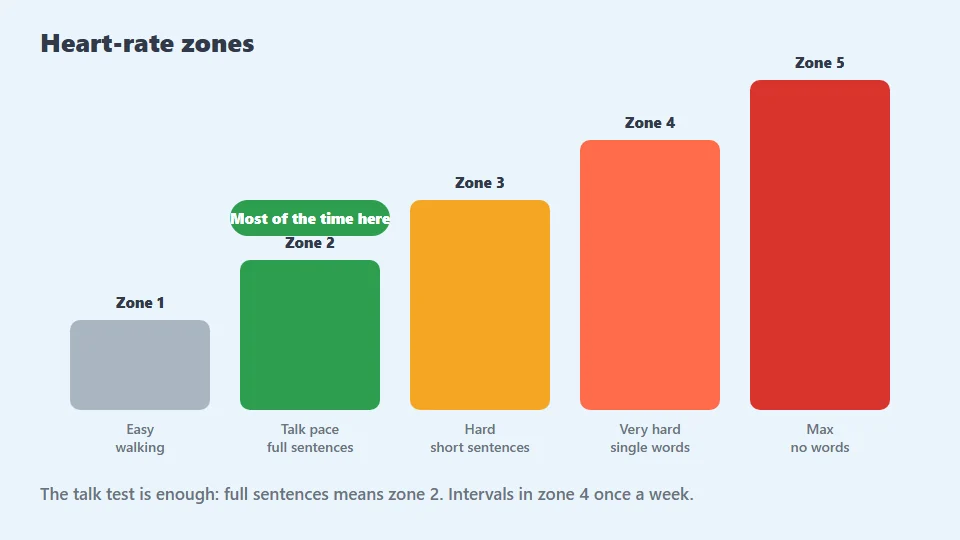
A work test on an ergometer bike where the load increases step by step until you cannot continue, with heart rate and ECG. The result is graded in capacity: a pass is capacity 5, and with at least 4 you may continue the assessment but must redo the test. The requirement is the same for women and men. The police recommend spinning where you really push yourself with resistance, and intervals. Exact watts or heart-rate values are not published – so the program trains hard bike intervals (4 × 4 minutes is the classic model) and a 20-minute test where you ride as hard as you can hold evenly.
The ISOKAI strength test
A machine lift the agency describes as ‘a deadlift of a barbell against resistance up to chin height’: legs, back, arms and shoulder girdle in a single pull, graded on a nine-point scale. A pass is capacity 3 for women and 6 for men; with 2 and 5 respectively you may continue the assessment but redo the test. The technique is shown on site by a nurse. The exercise in the police's own list that comes closest is the wide-stance deadlift with a high pull – which is why it returns together with kettlebell swings, deadlifts and barbell rows in the strength sessions.
The police exercise list
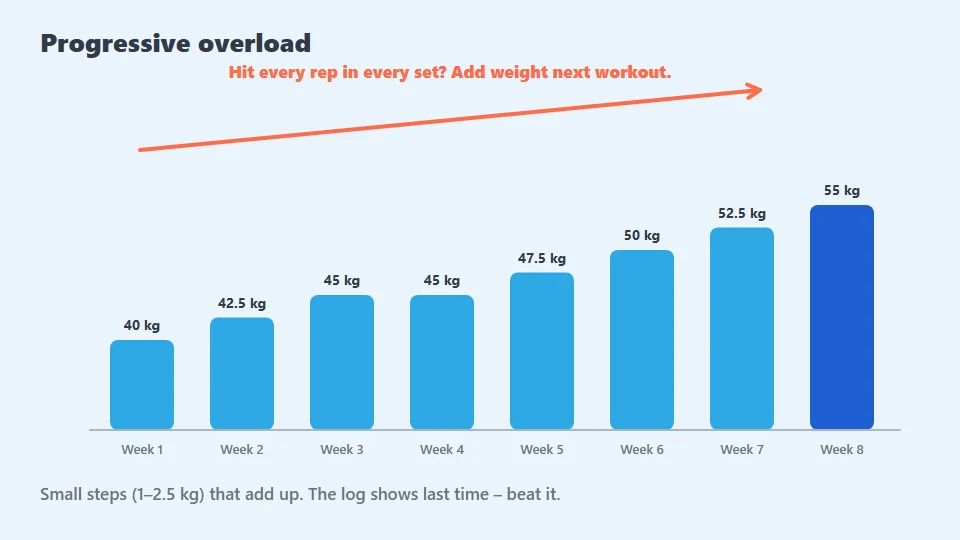
The training videos on polisen.se come with a list: a warm-up (side to side, half squat, inchworm, knee to chest, backward roll, high knees) and thirteen exercises: wide-stance deadlift with high pull, kettlebell swing, lunges, squats, barbell row, pull-ups, push-ups, burpees, plank, sit-ups, side plank, Russian twist and hanging from a bar. The advice is to adapt to your own ability and increase reps, difficulty or weight over time. The circuit sessions in the app are that list, in three levels.
Rules around the tests
Passed physical tests are valid for 24 months; after a fail there is a three-month waiting period before you can apply again. The police give a BMI guideline of 18–33 and point out that an officer carries 10–12 kg of equipment on duty.
About to change
In May 2026 a working group within the police proposed new admission requirements: a running test for endurance and movement ability (including terrain), ISOKAI measuring the maximum instead of the average, a complementary muscle test for upper body and core, and BMI 18.5–34.9. Distance and times for the running test were not set when this was written, and polisen.se still describes bike and ISOKAI. The program therefore has one running day a week – it does no harm and makes you ready if the running test is introduced.
How the program is laid out
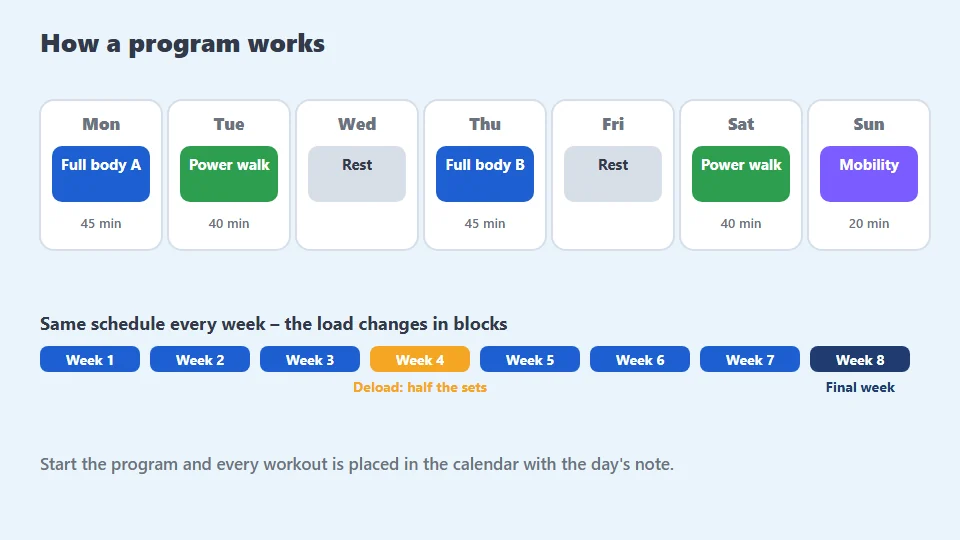
Monday the police circuit, Tuesday bike intervals, Wednesday swimming, Thursday strength for the lift, Friday running (intermediate and advanced). Weeks 4 and 8 are test weeks: the swim test for time, 20 minutes on the bike as hard as you can, and a test session with max attempts in push-ups, sit-ups, pull-ups, plank, hanging and a heavy high pull – not the real tests, but the same measures in week 4 and week 8 so you see what has changed.
Sources: polisen.se ‘Träna inför de fysiska testerna’ and ‘Fysiska krav i polisyrket’ (2026), the police exercise list ‘Träningsövningar för dig som vill bli polis’ (2019), pliktverket.se ‘Medicinsk och psykologisk prövning’ (2026), Polistidningen ‘Här är förslagen till nya antagningskrav’ (25 May 2026). The program is general training for the tests, not an official program of the police or the agency. If you have an injury or illness, talk to a healthcare professional before starting.
Sources and further reading are in the app under Learn. Passboken gives general advice and does not replace a doctor or dietitian. · Updated 2026-10-26
Programs that follow this
Get the app, pick the program and tap Start – the workouts are placed in your calendar and can be moved. Free, no ads.
Read more