
Training during and after pregnancy
The recommendations, what to avoid, the pelvic floor and the way back.
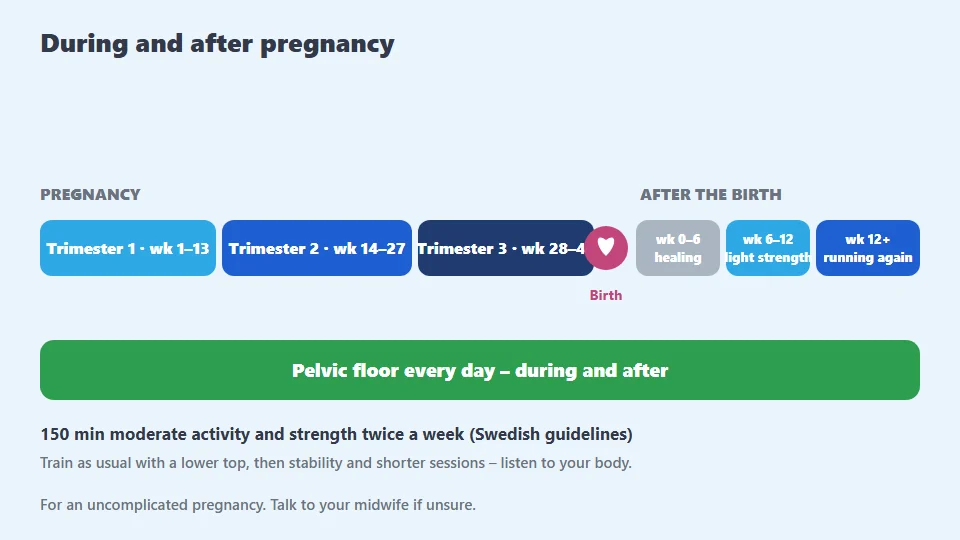
Training during pregnancy is good for both you and the baby: less fatigue, anxiety and low mood, lower risk of gestational diabetes, high blood pressure and excessive weight gain. This applies to an uncomplicated pregnancy – always talk to your midwife if unsure.
The recommendations
Swedish guidelines (FYSS, 1177) during and after pregnancy:
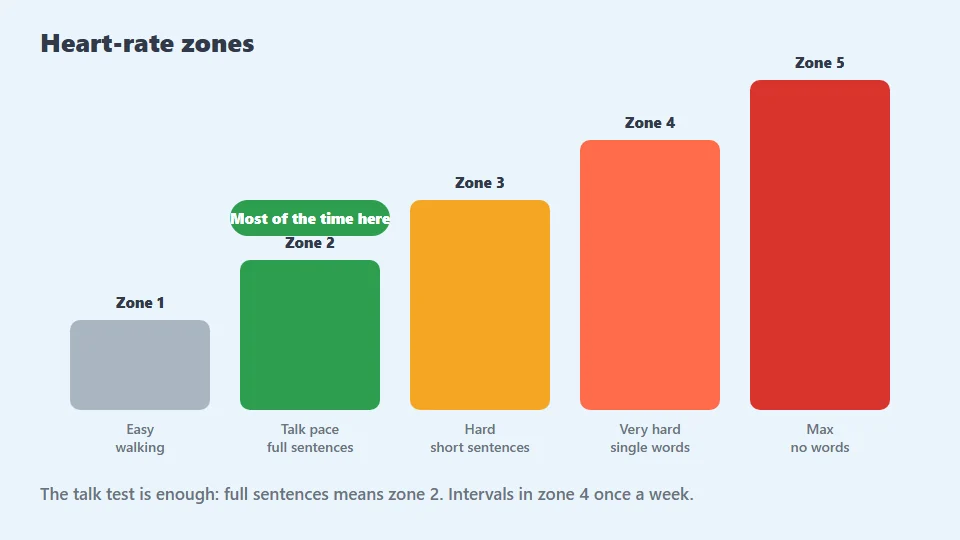
- At least 150 minutes of moderate aerobic activity a week – warm and breathing faster but able to talk.
- Strength training for the major muscle groups at least twice a week.
- Pelvic floor training every day, both during and after pregnancy.
- If you already train hard you can continue, adapting as you go.
Avoid
- Activities with a risk of falling or blows to the belly: riding, downhill skiing, skating, martial arts, contact team sports.
- Diving.
- Max lifts with breath-holding and exercises where the belly domes outward – crunches and full planks late in pregnancy.
- Long periods on your back in the second half if it feels uncomfortable (dizziness, nausea) – switch to side-lying or standing.
- Jumping and running if the pelvic floor objects: leakage or heaviness means lowering the intensity.
Trimester by trimester
Trimester 1 (weeks 1–13): train roughly as usual with a lower top. Fatigue and nausea decide. Trimester 2 (weeks 14–27): the centre of gravity shifts and the lower back arches – stability for hips, glutes and lower back, pelvic floor. Trimester 3 (weeks 28–40): shorter sessions, standing and side-lying. Squats and pelvic floor relaxation are preparation for birth.
Pelvic floor
Squeeze as when holding back urine, lift inward and upward, hold 3–5 seconds, release fully and rest as long. 8–12 contractions, ideally several times a day. Being able to relax the pelvic floor is as important as contracting – it is preparation for birth.
After the birth
Recovery takes at least a year and most of it happens in the first three months. A reasonable ladder:
- Weeks 0–6: pelvic floor, breathing, gentle abdominal activation, walks.
- Weeks 6–12: after the check-up, low-intensity strength without jumping.
- Week 12 onwards: gradually back to running and jumping once you can jump and cough without leakage or heaviness.
After a caesarean or a larger tear it is slower – follow your care team's advice.
Separated abdominals
Most people have some diastasis recti after pregnancy. Training the abdomen is not dangerous, but the belly should stay flat and not bulge during exercises. Start with breathing and the deep abdominals, not crunches. If problems remain – leakage, heaviness, a bulging belly – ask for a physiotherapist. It is common and can be trained.
Train to feel good, not to "get back". Sleep when you can.
Sources and further reading are in the app under Learn. Passboken gives general advice and does not replace a doctor or dietitian. · Updated 2026-10-26
Programs that follow this
Get the app, pick the program and tap Start – the workouts are placed in your calendar and can be moved. Free, no ads.
Read more